
Foundation Model vs LLM: Key Differences in AI Architecture
Foundation Model vs LLM Core Differences | TL; DR
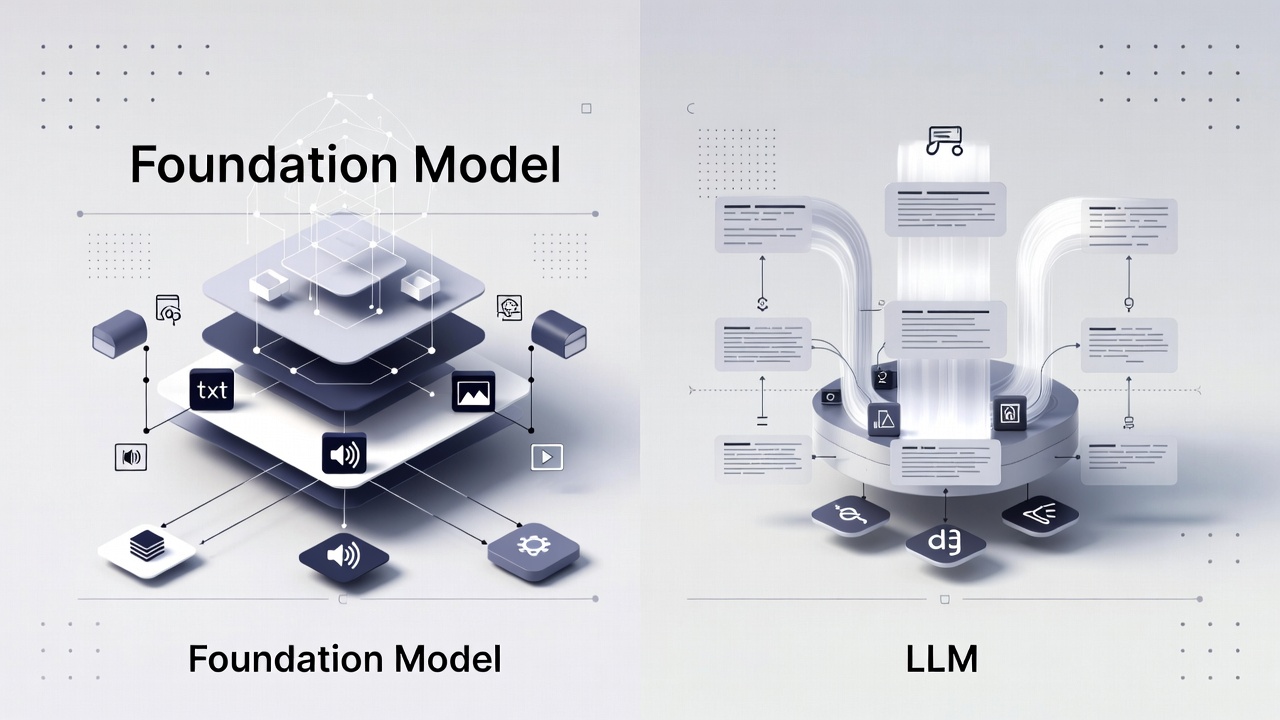
Foundation models are large-scale, pre-trained AI systems that serve as a base for various applications, while Large Language Models (LLMs) are a specific, specialized type of foundation model trained primarily on text.
All LLMs are foundation models, but not all foundation models are LLMs, as some handle images, audio, or multimodal data.
Key Differences between Foundation Model vs LLM
- Modality: LLMs are restricted to human language and code. Foundation models include broader architectures like Computer Vision models for images or Robotics models for physical interaction.
- Infrastructure: Foundation models are typically more resource-intensive and expensive to host due to their multimodal nature (handling video or high-res images).
- Adaptability: FMs serve as a "bedrock" for various applications. For example, a foundation model can be fine-tuned into a text-only LLM, a vision-language assistant, or a medical diagnostic tool.
Which one to choose?
- Choose an LLM if your project revolves entirely around text, such as automating support tickets, writing copy, or analyzing legal documents.
- Choose a Foundation Model if your project requires "cross-signal reasoning," such as interpreting a scanned medical form alongside a patient's voice notes.
What Is a Foundation Model?
A foundation model is a large-scale AI system pre-trained on a massive and diverse dataset. Its core purpose is to learn general-purpose knowledge and patterns that can be adapted, or "fine-tuned," for a wide range of downstream tasks without starting from scratch. The term was coined by researchers at Stanford HAI, capturing the idea that these models serve as a foundational base for building specialized applications.
The power of a foundation model lies in its training. It typically uses self-supervised learning on a dataset that can include text, images, audio, video, and structured data. By learning the relationships between these different types of information, it develops a versatile understanding. For example, a foundation model can learn that the word "apple" is statistically linked to images of a red fruit, tech company logos, and discussions of nutrition.
Key Characteristics:
- Multimodal: Processes and connects multiple data types (text, image, audio).
- Generalizable: Learns broad representations transferable across domains.
- Adaptable: Can be fine-tuned for specific applications with relatively little task-specific data.
Leading examples include GPT-4 (OpenAI), Gemini (Google), and Claude 3 (Anthropic), which, while often used for text, are built as multimodal systems from the ground up. Other pioneering examples are even more specialized, like Newton by Archetype AI, a foundation model built to understand real-world physical sensor data for manufacturing and logistics.
What Is a Large Language Model (LLM)?
A Large Language Model (LLM) is a specialized subset of a foundation model. It is trained exclusively on textual data, think books, articles, code repositories, and website, soften encompassing trillions of words. Its primary function is to understand, generate, and manipulate human language.
LLMs are the engines behind the chatbot revolution. They operate by predicting the next most likely word in a sequence, but at a scale that enables sophisticated reasoning, writing, and coding. They excel in tasks where the input and output are purely linguistic.
Key Characteristics:
- Language-Specialized: Trained deeply on text and code syntax, grammar, and semantics.
- Context-Aware: Tracks conversation history and long-form context to generate coherent responses.
- Optimized for Generation: Excels at text creation, summarization, translation, and question-answering.
Prominent LLMs include the GPT series for general chat and content, Llama (Meta) for open-source applications, and specialized models like Claude, which emphasizes safety and long-context reasoning. In specialized U.S. industries like biotech, companies are building domain-specific LLMs. For instance, Atomic AI uses a large-language-model component for RNA drug discovery.
The Decision Framework: How to Choose for Your U.S. Business
The question is not which model is "better," but which is appropriate for your specific business problem. Based on hundreds of client engagements across America, we use this simple decision flow.
Start by analyzing your data: What is the nature of the information your AI needs to process?
- If it's ONLY TEXT (emails, reports, contracts, code, chat logs) → Start with an LLM. You will get to a proof-of-concept faster and at a lower initial cost. For example, a U.S. financial services firm used a fine-tuned LLM to read thousands of loan applications and compliance documents, automating a process previously done manually.
- If it's MULTIPLE FORMATS (text + images, text + audio, video + metadata) → You need a foundation model. An LLM alone will be blind to the visual or audio components. A U.S. manufacturer, for instance, used a vision-centric foundation model to analyze real-time sensor data and camera feeds from assembly lines to predict equipment failure, a task impossible for a text-only LLM.
Strategic Considerations for American Enterprises
- Total Cost of Ownership (TCO): While using a pre-trained model via an API (like OpenAI or Anthropic) lowers upfront cost, long-term, high-volume use may necessitate a private, fine-tuned model. LLMs often offer more cost-effective paths to privatization.
- Compliance & Governance: U.S. industries like healthcare (HIPAA) and finance (SEC) have strict rules. Text-based workflows with LLMs are generally easier to log, audit, and redact. Multimodal foundation models handling sensitive images or patient records require robust, built-in governance frameworks from day one. Partners like IBM Watsonx and Deloitte AI emphasize this governance-first approach.
- The Future-Proof Portfolio: Leading enterprises don't standardize on one model. They build a model portfolio, using orchestration layers to route tasks to the best-suited model, a cost-effective LLM for internal Q&A, a powerful multimodal foundation model for customer-facing product guides. This is the architecture modern U.S. AI development companies are building.
The Evolving Landscape: What's Next for U.S. Adoption
The line between LLMs and foundation models is blurring. The trend is toward "multimodal LLMs",models with strong language cores that can also natively process other formats. For American businesses, this means the strategic focus is shifting from choosing one model type to building a capable and governed AI infrastructure.
We will see a rise in:
- Domain-Specific Foundation Models: Pre-trained for industries like U.S. healthcare, law, or biotech, accelerating time-to-value.
- Smaller, More Efficient Models: Reducing the cost and latency of deploying multimodal intelligence.
- AI Agent Ecosystems: Moving beyond simple chat to systems where models use tools, make decisions, and execute multi-step workflows autonomously.
