
Courier Delivery App Development | Custom Logistics Solutions
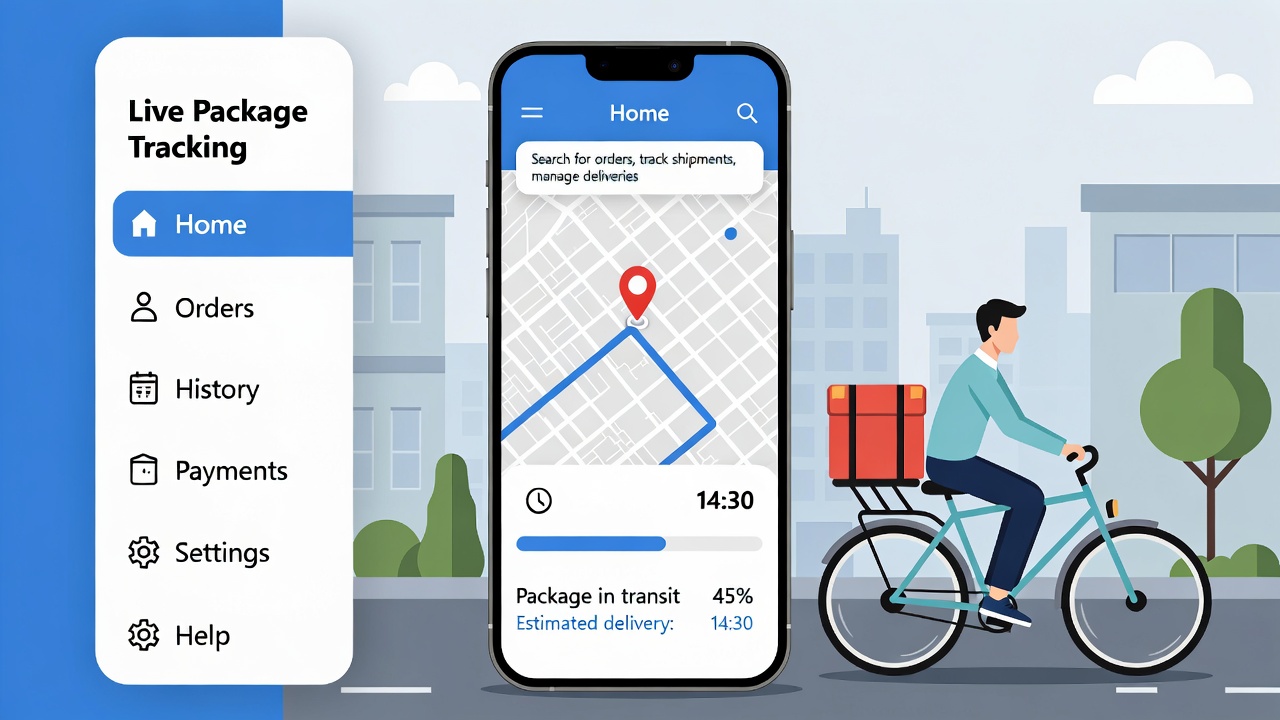
Courier Delivery App Development in USA in 2026 | TL; DR
Developing a courier delivery app involves a multi-stakeholder system, typically comprising a Customer App, a Courier/Driver App, and an Admin Dashboard.
1. Key Features of Courier Delivery Application by User Type
Customer App:
- Parcel Booking: Enter dimensions, weight, and destination to get instant price estimates.
- Real-time Tracking: Live GPS updates of the courier's location.
- Secure Payments: Integration with Stripe, PayPal, or digital wallets.
- Push Notifications: Alerts for pickup, transit, and delivery completion.
Courier/Driver App:
- Route Optimization: AI-driven shortest path navigation using Google Maps API or Mapbox.
- Status Management: One-tap acceptance/rejection of orders and delivery status updates.
- Proof of Delivery (PoD): Digital signatures, photo uploads, or OTP verification.
Admin Dashboard:
- Fleet Management: Real-time monitoring of all couriers and parcels.
- Analytics: Reports on delivery times, fuel efficiency, and revenue.
2. Development Process of Courier Delivery App Development
- Market Research: Define your niche (e.g., medical, furniture, or grocery delivery) and business model (aggregator like Uber vs. branded enterprise).
- UI/UX Design: Create wireframes and a clickable prototype to ensure a low learning curve for drivers and customers.
- Tech Stack Selection:
- Frontend: Flutter or React Native for cross-platform efficiency.
- Backend: Node.js, Python, or PHP for server-side logic.
- Cloud: AWS or Google Cloud for reliable hosting and scalability.
- MVP Development: Launch a Minimum Viable Product with core features to test the market before building an enterprise-grade solution.
- Testing & Launch: Rigorous QA for security (GDPR compliance) and performance under high traffic.
Comparing Development Approaches for U.S. Businesses with Cost Calculation
Core Business Models for Courier Delivery Apps
Your app's architecture and features depend heavily on the business model you choose to serve.
Each model targets a specific segment of the delivery ecosystem.
- Parcel Delivery & Postal Service Apps: This model is ideal for established courier corporations or new entrants aiming for a broad market. Think of applications like FedEx Mobile or DHL Express. These apps allow users to schedule pickups, calculate shipping rates, and track parcels across national or global networks. They often require complex integration with legacy logistics systems and a focus on reliable, scheduled deliveries rather than instant on-demand service.
- Same-Day & On-Demand Delivery Apps: This model caters to the immediate need for speed, popular in urban and suburban areas. Services like Uber Connect exemplify this model. The core value proposition is getting a package across town within hours. These apps typically utilize a dynamic network of independent driver-partners, require robust real-time tracking, and feature simplified, instant booking processes.
- E-commerce and Retail Logistics Apps: These are white-label or integrated solutions designed specifically for online stores. They seamlessly connect a merchant's order management system with last-mile delivery execution. Features like seamless returns processing, branded tracking pages, and scheduled delivery windows are critical here. Major players like Amazon Logistics have set the standard, but there is massive room for specialized providers catering to small and medium-sized U.S. businesses.
- Local Courier & Hyper-Local Delivery Apps: This model serves a confined geographic area, a city, neighborhood, or even a campus. It focuses on extreme convenience for errands like document drops, grocery deliveries, or local gift sending. The emphasis is on low cost, hyper-fast turnaround, and deep familiarity with local geography. While less common as standalone apps in the U.S., this functionality is often a feature within broader on-demand service platforms.
- B2B (Business-to-Business) Delivery Apps: Designed for efficiency over consumer appeal, B2B apps manage bulk shipments, pallet-level logistics, and regular supply chain deliveries between warehouses, distributors, and retailers. Features like batch shipment creation, manifest generation, pallet tracking, and integration with Enterprise Resource Planning (ERP) systems are paramount.
Must-Have Features for a Competitive Courier Delivery App
A successful app is a triad of interconnected panels: one for the Customer, one for the Driver/Delivery Agent, and one for the Admin/Dispatcher. Each requires a tailored feature set.
Customer Panel Features
The customer-facing app must be intuitive and build confidence.
- Frictionless Booking: A simple, step-by-step process to enter pickup/drop-off details, package specs, and choose a service level (standard, express, etc.).
- Real-Time GPS Tracking with ETA: Live map view showing the driver's location and a dynamic, accurate estimated arrival time.
- Multiple Payment Options: Secure integration with credit/debit cards, digital wallets (Apple Pay, Google Pay), and sometimes cash-on-delivery.
- Digital Proof of Delivery: In-app delivery confirmation via one-time password (OTP), recipient e-signature, or a photo of the delivered package.
- In-App Communication & Support: Direct chat or call functionality with the driver or support team to resolve last-minute issues.
- Rating & Review System: Allows customers to feedback on the delivery experience, providing valuable data for service improvement.
Driver/Delivery Agent Panel Features
This app is a tool for productivity and clarity.
- Intelligent Task Queue & Acceptance: Clear display of assigned pickups and deliveries, often with an accept/reject toggle for gig-economy models.
- Integrated Navigation: One-tap opening of optimized routes in Google Maps or Waze, using the app's own AI-powered routing logic.
- Digital Workflow Tools: Scanners to capture package barcodes, tools to collect e-signatures or OTPs, and easy status update buttons (Picked Up, In Transit, Delivered).
- Earnings Dashboard: Transparent, real-time view of daily/weekly earnings, completed trips, and incentives.
- Availability Toggle: Allows drivers to easily go online or offline.
Admin & Dispatcher Panel Features
This web-based dashboard is the mission control center.
- Centralized Fleet & Driver Management: View all active drivers, their locations, statuses, and performance metrics.
- Automated Dispatch & Order Management: Manually assign or use AI to auto-assign deliveries based on location, capacity, and priority.
- Advanced Analytics Dashboard: Key metrics on delivery volumes, success rates, average delivery times, driver performance, and revenue.
- Customer & Support Management Interface: Access to customer data and tools to resolve escalated issues.
- Financial Reporting & Payout Management: Tools to handle driver settlements, generate invoices, and track overall profitability.
The Development Process: A Step-by-Step Roadmap of Building Courier Delivery Application
Building a robust courier app is a systematic process. At our development firm, we follow an agile, phase-driven approach to ensure alignment with business goals.
- Discovery & Strategy (Weeks 1-2): We start by deep diving into your specific business operations, target audience, and competitive landscape. This phase defines the core feature set, chooses the primary business model, and establishes key performance indicators (KPIs) for success.
- UI/UX Design (Weeks 3-6): Our designers create wireframes and interactive prototypes for all three panels (Customer, Driver, Admin). The focus is on creating intuitive, efficient user journeys. For example, the driver's app must allow critical actions to be performed in seconds, often while mobile.
- Technical Architecture & Planning (Week 7): We select the technology stack. For performance, native development (Swift for iOS, Kotlin for Android) is often recommended, though cross-platform frameworks like Flutter can be a cost-effective choice for MVPs. We architect the backend for scalability, typically using cloud providers like AWS or Google Cloud.
- Core Development & Integration (Months 2-5): The development team builds the app in agile sprints. This phase includes integrating critical third-party services:
- Maps & Geolocation: Google Maps Platform or Mapbox for tracking and routing.
- Payments: Stripe, Braintree, or PayPal for secure transactions.
- Communications: Twilio or Firebase for SMS and push notifications.
- Cloud Infrastructure: AWS/Azure for hosting and data storage.
- Quality Assurance & Testing (Ongoing): Rigorous testing is non-negotiable. We conduct functional testing, usability testing, performance load testing, and security penetration testing. This ensures the app works seamlessly across different devices, networks, and use cases.
- Deployment & Launch (Week Final): We assist in deploying the app to the Apple App Store and Google Play Store, managing the submission guidelines and requirements.
- Post-Launch Support & Iteration (Ongoing): After launch, we monitor performance, fix any emergent bugs, and plan iterative updates based on user feedback and analytics. Ongoing maintenance typically costs 15-25% of the initial development fee annually.
Understanding Development Cost and Timeline
The cost to develop a courier delivery app in the U.S. varies dramatically based on complexity, features, and the development partner's location.
- Basic MVP (Minimum Viable Product): A functional app with core features for one platform (iOS or Android), a simple admin panel, and basic tracking. Timeline: 3-4 months. Cost Range: $20,000 - $40,000.
- Mid-Market Solution: A more robust app for both iOS and Android, featuring advanced routing, a driver app, a comprehensive admin dashboard, and multiple payment integrations. Timeline: 5-8 months. Cost Range: $40,000 - $100,000.
- Enterprise-Grade Platform: A fully-featured, scalable ecosystem with white-label options, AI/ML for predictive analytics, IoT integration for fleet management, advanced microservices architecture, and custom integrations. Timeline: 9+ months. Cost Range: $80,000 - $250,000+.
Key Cost Drivers:
- Development Team Location: Hourly rates differ significantly. North American teams range from $100-$180/hour, while Eastern European teams offer strong expertise at $40-$70/hour.
- Feature Complexity: AI/ML features, complex real-time algorithms, and custom integrations add considerable cost.
- Design Sophistication: A custom, branded UI/UX requires more investment than a template-based design.
- Ongoing Costs: Remember to budget for app store fees, server hosting, third-party API usage fees (for maps, SMS, etc.), and annual maintenance.
Future Trends Shaping American Courier Apps
Staying ahead means building for tomorrow's trends today.
- AI and Predictive Analytics: Beyond basic routing, AI will forecast delivery delays by analyzing traffic, weather, and historical data. It will also optimize driver allocation and predict localized demand surges.
- Sustainability and Green Logistics: Consumers and regulators are prioritizing eco-friendly practices. Apps will feature "green delivery" options, optimize routes for fuel/electric vehicle efficiency, and provide carbon footprint reports.
- Expanded Automation: The integration point for autonomous delivery robots and drones will be the courier app. Companies like FedEx are already testing solutions like their Roxo delivery robot. Software will need to manage these hybrid human/AI fleets.
- Hyper-Personalization: Machine learning will enable apps to learn individual customer preferences, favorite delivery times, safe drop-off locations, communication channels—creating a tailored delivery experience.
