
Enterprise AI Agent Development: What CTOs Get Wrong
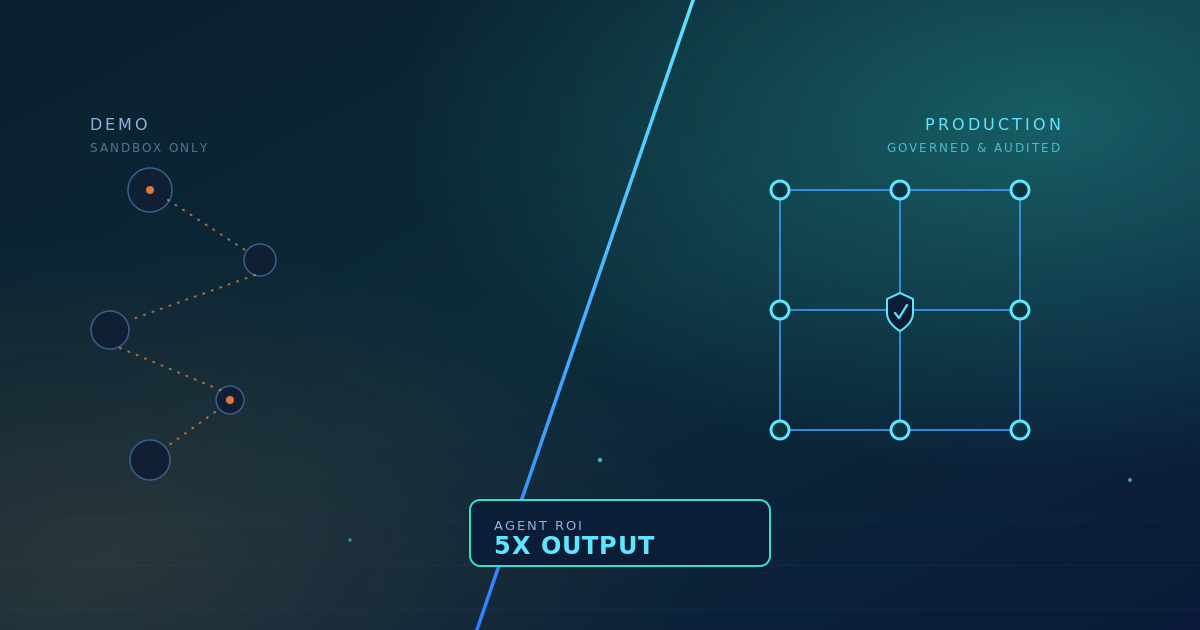
"Enterprise AI agent development" is not the same conversation as "how do I spin up an agent for free." One is a hobbyist experiment; the other is a production commitment with a system of record, an audit trail, and a CFO asking for the number. Most of what ranks for "AI agents" right now is written for the former. This is written for the latter.
Gartner is blunt about where that gap leads: "Over 40% of agentic AI projects will be canceled by the end of 2027, due to escalating costs, unclear business value or inadequate risk controls," the firm predicted in June 2025. Anushree Verma, Senior Director Analyst at Gartner: "Most agentic AI projects right now are early stage experiments or proof of concepts that are mostly driven by hype and are often misapplied."
The demo is not the hard part. Embedding an agent into a real workflow, governing it the way you'd govern any system with write access to production data, and measuring it the way a CFO measures any other capital investment — that's the hard part, and it's where most enterprise agent initiatives quietly stall. This post covers the three mistakes that cause the stall, an honest build-vs-partner framework, what production-grade agent work actually requires, and how to measure ROI in terms a CFO will accept.
Why Enterprise AI Agents Fail After the Demo
A working demo proves a model can follow instructions in a sandbox. It proves nothing about whether the agent can be trusted with a live ERP record, a customer account, or a clinical system — and enterprises that treat the demo as the finish line are the ones Gartner's forecast describes.
Part of the problem is vendor noise. Gartner notes that "many vendors are contributing to the hype by engaging in 'agent washing' — the rebranding of existing products, such as AI assistants, robotic process automation (RPA) and chatbots, without substantial agentic capabilities," and estimates "only about 130 of the thousands of agentic AI vendors are real." If the tooling isn't actually agentic, no amount of governance discipline will make it production-ready.
The other part is architectural. McKinsey's March 2026 report, "State of AI trust in 2026: Shifting to the agentic era" (Gabriel Morgan Asaftei, Roger Roberts, Abby Sticha, and Cécile Prinsen), frames the shift precisely: "In the age of agentic AI, organizations can no longer concern themselves only with AI systems saying the wrong thing; they must also contend with systems doing the wrong thing, such as taking unintended actions, misusing tools, or operating beyond appropriate guardrails." A chatbot that gives a wrong answer is a support ticket. An agent that takes a wrong action against a system of record is an incident.
None of this means enterprise agents don't work — it means they need to be engineered, not just prompted, before they touch anything that matters.
Mistake 1: No Evaluation or Guardrail Strategy
McKinsey's 2026 survey — roughly 500 organizations, polled between December 2025 and January 2026, among respondents "who hold direct responsibility or expertise in AI governance, risk management, or AI investment decisions" — found that "74 percent of respondents identify inaccuracy and 72 percent cite cybersecurity as highly relevant risks" for agentic AI. More tellingly, "nearly two-thirds of respondents cite security and risk concerns as the top barrier to fully scaling agentic AI, well ahead of regulatory uncertainty or technical limitations." Those aren't abstract concerns — they're the direct consequence of shipping an agent without an evaluation harness or a boundary on what it's allowed to do.
A governed agent needs both: a way to measure whether its outputs stay accurate as data drifts, and a hard limit on what actions it can take regardless of what it "decides" is correct. HMT's AI-Led Software Engineering practice treats these as one discipline — model evaluation and secure API deployment sit inside the same workflow as governance and monitoring, not as separate afterthoughts.
HMT's Chat to SQL product illustrates this architecturally: read-only by design — it "never modifies or deletes data" — RAG-grounded against the client's actual database, with role-based access control on top. None of that removes the need for evaluation; it narrows the blast radius so an evaluation gap doesn't become a production incident.
On a recent customs-portal integration for a logistics firm in Dubai, HMT built an intelligent document processing pipeline — AI OCR plus LLM prompts to interpret the extracted data — as the core of the engagement. It worked on the documents it was tested against. It did not survive contact with real submission volume: filings running past 50 pages, inconsistent portrait/landscape orientation, and performance that degraded on complex documents in ways a small test set never exposed. None of that surfaced until a live trial ran the pipeline against real filings. The fix wasn't a better prompt — it was a business rule engine, built specifically to normalize and validate the extracted data before anything downstream could trust it, added only after the trial showed exactly where the model's raw output couldn't be taken at face value.
Mistake 2: Agents With No System-of-Record Integration
Gartner names this as a primary failure mode: "Integrating agents into legacy systems can be technically complex, often disrupting workflows and requiring costly modifications." An agent that only talks to a sandbox, a spreadsheet export, or a demo database has proven nothing about whether it can survive contact with the ERP, CRM, or case-management system that actually runs the business.
This is the specific problem HMT's Nunar product is built to solve: an AI-agent system that reads unstructured input — WhatsApp messages, email, spreadsheets, scanned documents — and has agents extract, validate, and structure that data before it reaches the system of record, then updates ERP or CRM systems automatically. That pattern saves 80+ hours per month per department, cuts 80% of manual tasks, and delivers 5x more output from the same team without adding headcount. Those figures are HMT's own product data, not attached to a named client engagement — but they show exactly the integration point a sandboxed demo skips.
See it in practice: Nunar is HMT's own agent-driven automation product, built on the same pattern above — extract, validate, write to the system of record. If your pilot is stuck talking to a spreadsheet instead of your live systems, request an AI Strategy Review to map this onto your own stack.
The same customs-portal engagement made the integration mistake concrete from the other direction: the portal itself had to be operated, not just read from. HMT built bots to handle data entry into the portal's own interface, including navigating multiple popups mid-submission — the kind of live-system quirk that never shows up when an agent is only tested against a clean API or a sandboxed export. Getting a model to understand a customs document is a different problem than getting an agent to reliably submit that document through a government system's own multi-step web interface, and it's the second problem that actually decides whether the pipeline ships.
For the specific access-control and audit-trail patterns that separate a read-only integration from a write-capable one — and what a security review typically asks for before either goes live — see Enterprise AI Agent Integration: Patterns That Work Across CRM, ERP, and Operations Systems.
Mistake 3: Ignoring Governance and Auditability
Governance maturity industry-wide is still low. McKinsey found that "only about one-third of organizations report maturity levels of three or higher in strategy, governance, and agentic AI governance," even though the average score moved from 2.0 in 2025 to 2.3 in 2026. Ownership matters more than most assume: organizations that assign clear ownership for RAI average a maturity score of 2.6; those without a clearly accountable function average just 1.8.
An agent without an audit trail can't be governed after the fact — you find out what it did when a customer or a regulator asks. Chat to SQL's design is one concrete illustration of the default that should apply everywhere an agent touches production data: role-based access control, no external storage of raw data, read-only by default.
This piece stays focused on the organizational mistake, not the full build-out. For the regulatory frameworks (NIST AI RMF, EU AI Act) and technical controls a complete governance program needs, see AI Agent Governance Framework: Guardrails for Autonomous Systems. For what a governance gap looks like when it's discovered mid-engineering-handoff — and the pre-dispatch approval gate that fixes it — see Enterprise AI Agent Architecture: What CTOs Need to Evaluate Before the Engineering Team Starts Building.
Build vs. Partner: An Honest Decision Framework
Given Gartner's vendor math — only about 130 of thousands of agentic AI vendors have substantial agentic capabilities — and McKinsey's finding that security and risk concerns are the top barrier to scaling (well ahead of regulatory uncertainty or technical limitations), the build-vs-partner decision isn't really about cost. It's about who owns the integration and governance work described above.
HMT's own engagement model answers that question before committing to either path: a free 30-minute scoping call, a 2-week AI Readiness Assessment that maps legacy debt, data architecture, and deployment blockers, then a prioritized roadmap. Most clients see an MVP within 6 weeks and measurable outcomes in 6–8 weeks; where accelerators apply, they cut development timelines 40–70%. That sequence — diagnose before you commit — is the honest version of "build vs. partner": most enterprises don't yet know enough about their own data readiness to decide responsibly, and a two-week assessment is cheaper than finding out mid-rollout.
Partner models also differ. An agency reselling or configuring third-party agent tooling under a retainer solves a different problem than an engineering partner that owns integration into your system of record and governance requirements. The two aren't interchangeable — it's a fair question to ask any prospective partner which one they are.
For a deeper look at which agent use cases are delivering measurable ROI today, see Knowledge-Based AI Agents in Enterprise Operations — this post stays focused on the mistakes and the decision framework, not the use-case catalog.
What Production-Grade Enterprise Agents Actually Require
One caveat: neither of the following is an AI-agent deployment. Max Healthcare and GS1 India are HMT modernization engagements, cited here as evidence of the underlying engineering discipline — phased delivery, zero-downtime constraints, sequencing by risk — that production-grade agent work also requires. They are not agent case studies themselves.
At Max Healthcare, HMT modernized a hospital information system across 22 facilities, 5,000+ beds, and 5,000+ clinicians — 17 critical HIS modules, 1,000+ screens, zero disruption to live clinical workflows. The team didn't start with the hardest module; they started with inpatient pharmacy, the most independent module with the least tight integration to the other 16 — the lowest-risk place to prove the delivery model before expanding. Results: a 150% increase in screens delivered per day, a 50% reduction in go-live time, a 70% reduction in development effort, 300 screens live within 6 months, and a Net Promoter Score of 10. Nikhil Goel, VP & Head IT – Projects at Max Healthcare: "Thanks to Niral.ai, we achieved faster UI development, better component reusability, and reduced costs. Its AI-generated code is impressively close to Figma designs."
At GS1 India, HMT modernized a traceability platform built on undocumented legacy systems with zero tolerance for downtime, won through competitive tender. The team sequenced the same way: data design and migration first, then a small customer subset, then full-base scale-up — not a day-one cutover. Result: a platform handling 70 TPS (3x the previous throughput), processing 100,000 rows in seconds, with a 30% reduction in cloud costs and a 30% reduction in admin work.
The common thread: start with the smallest, most bounded piece of the system, prove the delivery model there, and expand only once it's rollback-ready. This is exactly the discipline an enterprise agent program needs before its first agent gets write access to a system of record — and it's the discipline most stalled pilots skipped.
Measuring ROI a CFO Will Accept
A CFO doesn't need to hear that AI is important. Gartner's own forecast makes the market trajectory clear: "at least 15% of day-to-day work decisions will be made autonomously through agentic AI by 2028, up from 0% in 2024," and "33% of enterprise software applications will include agentic AI by 2028, up from less than 1% in 2024." That's the market case. What a CFO wants is the unit economics of a specific initiative: hours saved, tasks eliminated, output per team, and a timeline to first measurable outcome.
That's the same shape of proof HMT applies to its agent product. Nunar's figures — 80+ hours saved per month per department, 80% of manual tasks cut, and 5x more output from the same team, without adding headcount — are attached to a product capability rather than a single named client, but they're specific and auditable, unlike a vaguer "efficiency gains" claim.
On timeline, HMT's engagement model sets the expectation: a 2-week AI Readiness Assessment, an MVP in 6 weeks, measurable outcomes in 6–8 weeks — a schedule a CFO can put a number against. Skipping this discipline has a cost too: Gartner's 40%-by-2027 cancellation forecast is, functionally, a forecast of write-offs at companies that didn't build this case before they started.
Before any enterprise agent program begins, put three numbers on the table: hours or tasks displaced, cost per unit of output before and after, and time to first measurable outcome. If a vendor or an internal team can't produce those numbers with that specificity, the program isn't ready to leave the demo stage and operate securely at scale.
Request an AI Strategy Review
Enterprise AI agent development doesn't fail because the technology isn't ready. It fails when evaluation, integration, and governance get treated as problems for later. If your organization has a stalled pilot, or a board mandate to "do something with AI" and no credible path to production, request an AI Strategy Review — it starts the same way every engagement above did: a scoping call and a diagnostic, before a single line of code.
