
Application Modernization Strategy: The 2026 Framework
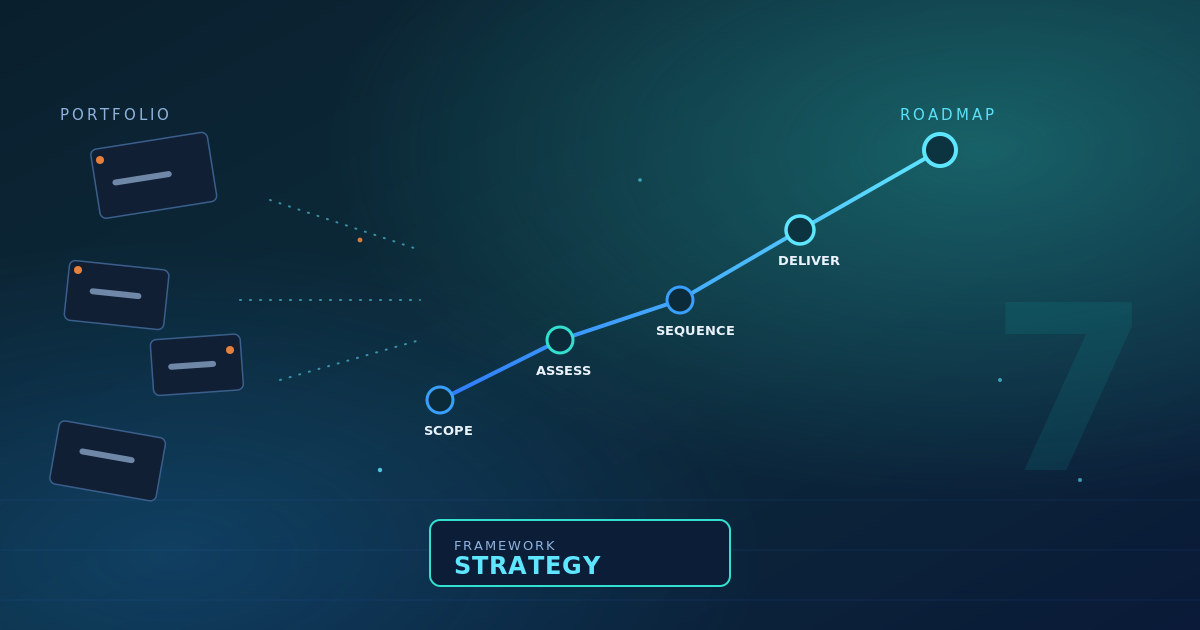
A working application modernization strategy is not a list of which applications get lifted, replatformed, or rewritten. It is a decision system: a documented method for assessing a portfolio, sequencing the work, controlling risk, and deciding what to build in-house versus bring in outside delivery for — before a single line of legacy code changes. Most modernization efforts stall or blow their budget not because teams pick the wrong technical approach, but because they never built that decision system first. This guide covers what a modernization strategy needs to define, a framework for assessing and sequencing the portfolio, and a reference model — built on HMT's own delivery process — you can adapt directly.
The pressure to get this right is not abstract. As much as 70 percent of the software used by Fortune 500 companies was developed 20 or more years ago, according to McKinsey's research on IT modernization — and at one large European bank, 70 percent of IT capacity went to simply maintaining legacy systems. In U.S. federal government alone, agencies reported spending roughly 80 percent of a $100+ billion annual IT budget on operating and maintaining existing systems, per the U.S. Government Accountability Office. That figure is federal-specific, not general-enterprise — but the maintenance-crowding-out-modernization pattern it describes is the one most CTOs are trying to reverse.
What an Application Modernization Strategy Actually Needs to Define
Before any technical decision gets made, a real application modernization strategy answers five questions in writing:
- Scope — which applications, systems, or modules are in play, and which are explicitly out of scope for this phase.
- Prioritization criteria — the objective factors (business risk, technical debt, integration complexity, compliance exposure) used to decide what moves first.
- Approach per application — which of the modernization patterns applies to each system, not a single blanket approach for the whole portfolio.
- Sequencing and risk controls — the order of work and the rollback mechanism if something goes wrong mid-migration.
- Delivery model — what stays in-house, what gets outsourced, and how AI-led delivery accelerators fit into the timeline.
If a strategy document can't answer all five, it's a wish list, not a strategy. Teams that skip straight to "we're modernizing to microservices" without defining scope and sequencing first are the ones most likely to hit the risk CTOs name most often: a big-bang rewrite that disrupts live operations. A phased, rollback-ready approach — running old and new systems in parallel until the new one is proven — is the direct answer to that risk, and it's the backbone of the framework in the final section below.
For readers who need the foundational "what is modernization vs. migration" grounding before going further into strategy, HMT's cloud modernization basics guide covers that 101 layer. This article assumes that context and goes straight into strategy construction.
Assessing Your Portfolio: What to Modernize First (and What Not to Touch)
Not every application belongs in this phase of modernization. A defensible application modernization strategy sorts the portfolio into three buckets before any build work starts:
- Modernize now — high business risk, high technical debt, or a hard compliance/scaling deadline. These are the systems where standing still is the most expensive option.
- Modernize later — stable systems with moderate debt that aren't blocking growth today but will need attention within 12–24 months.
- Leave alone — systems that are working, low-risk, and not worth the disruption of touching right now. Modernization for its own sake is not a strategy goal.
The criteria that separate these buckets typically include: how much clinician-, customer-, or employee-facing risk the system carries if it fails; how well-documented and understood the codebase is; how tightly it's coupled to other systems; and whether a compliance, licensing, or vendor end-of-life clock is already running.
The prioritization logic held on both engagements, and neither started with the most visible module — they started with the most independent one. On Max Healthcare, the team began with the inpatient pharmacy module specifically because it was the least invasive to build and go live: it stood on its own, with no tight integration into the other 16 modules, which made it the safest place to prove the delivery model before touching anything more entangled. On GS1 India, the first target wasn't a feature at all — it was data design, followed by a DataKart rollout to a small subset of customers before scaling to the full base. Same rule in both cases: prove the model on the piece with the fewest dependencies, then expand.
Both engagements back this up at scale: Max Healthcare's modernization covered 17 critical Hospital Information System modules — 50 to 150 screens each, 1,000+ screens total — across 22 facilities and 5,000+ daily clinicians, without the disruption a big-bang rewrite would have caused. GS1 India's team inherited undocumented DataKart and DataTrace platforms with scattered institutional knowledge and rebuilt them on cloud-agnostic microservices under a no-downtime mandate. Neither team scaled before the first slice proved out.
Teams with an aging monolith to decompose can go deeper in HMT's microservices architecture comparison.
The 7 Rs, Applied: Choosing the Right Approach Per Application
Once a system lands in "modernize now" or "modernize later," the next decision is which pattern fits it. The industry shorthand for this is the 7 Rs — rehost, replatform, refactor, repurchase, rearchitect, rebuild, and retire. HMT has already published a full mechanic breakdown of this framework — see What Are the 7 Rs of Cloud Migration? for the detailed definition of each pattern and when it applies — and an earlier, narrower version in Choosing the Right Path: 5 R's of Application Modernization. We won't re-explain each R here; what matters at the strategy level is how the choice gets made.
The strategic mistake is treating the 7 Rs as a menu you pick once for the whole portfolio. In practice, a single portfolio typically uses several patterns simultaneously: a customer-facing app might get rearchitected into microservices, a stable back-office tool gets rehosted with no code changes, and a genuinely dead system gets retired outright. The strategy's job is to assign the right pattern to each application based on the criteria above — not to declare one company-wide modernization method.
A system with tightly coupled legacy logic and no appetite for a rewrite is also a candidate for incremental modernization patterns that don't require touching the core — HMT's PL/SQL to REST API modernization approach is a concrete example of extending a legacy system's life without a full rebuild, and mainframe-specific portfolios have their own considerations, covered in What Is Mainframe Modernization?
Sequencing and Risk: Avoiding the "Modernize Everything at Once" Trap
Picking the wrong pattern rarely sinks a modernization program. Trying to modernize too much of the portfolio at once does. Parallel workstreams across multiple critical systems multiply the blast radius of any single failure, strain testing, and make rollback much harder if something breaks in production.
A sequencing plan built around risk containment generally follows this structure:
- Start with a contained, high-value system — proves the delivery model works before scaling it.
- Run old and new in parallel — zero-downtime cutover, not a hard swap.
- Expand to the next tier only after the first system is stable in production — not on a fixed calendar, but a defined stability signal.
- Keep a rollback path live until the new system has proven itself under real production load, not just in staging.
Case study callout: Max Healthcare's HIS modernization is the clearest evidence this sequencing model works under real constraints. HMT's Core Team rebuilt clinical business logic while an Extension Team used the Niral.ai accelerator to convert Figma designs directly into production Angular code — running at 2.5 screens/day per sprint team, with 300 screens live within 6 months. The result: a 150% increase in screens shipped per day, a 50% reduction in go-live time, 70% less development effort, and zero disruption to 5,000+ daily clinicians across 22 facilities — with no weekend or night shifts required from the delivery team. Read the full Max Healthcare digital modernization case study or see how HMT structures this kind of phased, rollback-ready delivery on the AI-driven application modernization service page.
GS1 India applied the same discipline to a different failure mode — an undocumented legacy platform with zero downtime tolerance — and delivered 70 TPS (3x the previous throughput), processing 100,000 rows in seconds, alongside a 30% cloud cost reduction and 30% less admin work. Read the full GS1 India traceability platform case study. Neither engagement modernized everything at once; both sequenced the highest-risk pieces first and proved stability before expanding.
Build vs. Partner: What to Keep In-House vs. Bring in AI-Led Delivery
The last structural decision is who does the work. This isn't a binary in-house-versus-outsource choice. Most enterprise programs split the work across three lanes:
| Decision | Keep in-house | Bring in AI-led delivery partner |
|---|---|---|
| Domain/business logic decisions | Yes — your team owns the rules | Partner implements against your specifications |
| Legacy codebase assessment & technical debt mapping | Optional | Recommended for objective, portfolio-wide debt mapping ahead of the roadmap |
| Front-end rebuild at volume (e.g., screen-by-screen UI modernization) | Slower without accelerators | Where AI accelerators like Niral.ai show the clearest ROI — 70% faster front-end development |
| Backend/legacy system modernization (COBOL, mainframe, PL/SQL, ERP) | High risk if under-resourced | Accelerators like ADaM cut legacy backend rewrite time by up to 70% |
| Ongoing optimization after go-live | Typically in-house once stable | Partner support typically continues through the first 6–8 weeks post-kickoff, when most clients see measurable outcomes |
| Data migration and cutover | Case-by-case | Specialized tooling (e.g., HMT's DB Migration product) delivers 99.99% data accuracy and 60% faster cutovers |
Volume plus repetition is the clearest sign a workstream belongs with an outside partner — where an AI accelerator turns a team-size problem into a throughput problem, as it did on the Max Healthcare Extension Team: instead of scaling headcount to cover 1,000+ screens, the accelerator scaled output per sprint team.
Teams still deciding whether their initiative is a modernization project or a broader digital transformation program should read Digital Transformation vs Application Modernization: How CTOs Decide Which Path to Take First — scoping that correctly changes who needs to be in the build-vs-partner conversation. Teams building the financial case internally can go deeper on budget justification in Cloud Modernization ROI: The CIO's Business Case for 2026 and Mainframe Application Modernization Cost Calculation and Planning.
If the instinct is "too risky to hand to anyone else," that's usually a sign the risk conversation hasn't happened yet, not a reason to avoid outside delivery. The mitigations — phased rollout, rollback-ready cutover, zero-downtime parallel run — stay the same regardless of who does the work; only the speed changes.
A Reference Strategy Framework (Worked Example)
Here's a worked reference framework, built on HMT's own delivery process, that a CTO or Head of IT can adapt directly.
Step 1 — Scoping call (30 minutes, free). A structured conversation to establish rough scope: how many applications, what's driving the decision (compliance deadline, scaling ceiling, vendor end-of-life, technical debt), and who the internal stakeholders are.
Step 2 — AI Readiness Assessment (2 weeks). The diagnostic layer most modernization strategies skip. It maps legacy technical debt across the portfolio, current data architecture, and deployment blockers that would prevent AI-assisted delivery from working cleanly. The output feeds directly into Step 3, not a slide deck of generic recommendations.
Step 3 — Prioritized roadmap. Using the assessment findings and the "modernize now / later / leave alone" logic above, the roadmap sequences the portfolio by risk and business value, assigns a 7-Rs pattern to each application in scope, and defines the build-vs-partner split for each workstream.
Step 4 — MVP delivery (6 weeks). The first contained workstream goes live, following the sequencing and rollback discipline above. Most clients see measurable outcomes within 6–8 weeks of kickoff.
Step 5 — Expand and stabilize. Once the first system is proven stable in production, the next tier of the roadmap begins under the same parallel-run, rollback-ready pattern.
This is the process HMT runs, not a theoretical model, and Max Healthcare's numbers (150% more screens/day, 50% faster go-live, 300 screens live in 6 months with zero disruption) and GS1 India's numbers (70 TPS, 3x throughput, 30% lower cloud cost) are what it produced on two very different portfolios: one clinical and screen-heavy, one undocumented and throughput-critical. Both skipped the full rewrite and started with an assessment instead.
Where to Go From Here
A modernization strategy is only as good as the assessment underneath it. Guessing at technical debt, data architecture, and deployment blockers is how "modernize everything at once" plans get built. HMT's AI Readiness Assessment is the two-week diagnostic step in the framework above — the same process behind the Max Healthcare and GS1 India engagements referenced throughout.
Get your AI Readiness Assessment and get a prioritized modernization roadmap for your portfolio, not a generic recommendation deck.
