
AI Automation Agency Business Model Guide for Beginners | 2026 Updated

What is an AI Automation Agency Business Model in 2026?
The AI Automation Agency (AAA) business model in 2026 focuses on helping businesses optimize operations by integrating artificial intelligence into existing workflows. Unlike traditional agencies, AAAs specialize in deploying autonomous AI agents that handle repetitive tasks like lead generation, customer support, and data management with minimal human intervention.
Core Service Offerings by AI Automation Agencies to Attract Potential Clients
- Workflow Automation: Connecting disparate business tools (e.g., CRMs to email marketing) using platforms like Zapier, Make.com, or n8n to eliminate manual data entry.
- Conversational AI Agents: Building custom 24/7 chatbots and voice assistants for customer support and appointment booking using tools like Voiceflow or Botpress.
- Generative AI Development: Creating tools for automated content production, SEO-optimized copy, and personalized marketing campaigns.
- Predictive Analytics: Developing dashboards that use AI to forecast sales trends, customer churn, and inventory needs.
Pricing and Revenue Models for Long Term Revenue for AI Automation Agency
In 2026, most agencies use a hybrid approach to balance cash flow and scalability:
- Project-Based (Setup Fees): One-time fees for custom builds, typically ranging from $2,500 to $15,000+ depending on complexity.
- Monthly Retainer: Ongoing fees for maintenance, system optimization, and support, averaging $2,000 to $8,000/month.
- Performance-Based: Charging based on measurable results, such as a fee per qualified lead generated or a percentage of cost savings.
- Usage-Based / Token Billing: Fees tied to the volume of AI tasks or API tokens consumed by the client’s systems.
Implementation Strategy for Establishing an AI Automation Agency
- Niche Selection: Focus on a specific vertical (e.g., Real Estate, E-commerce, or Healthcare) where manual bottlenecks are well-defined.
- Paid Discovery Phase: Many successful 2026 agencies charge for an initial "discovery" to audit a client's workflows before committing to a full implementation.
- White-Label Solutions: Leveraging existing agent-building platforms to deliver high-quality tools under the agency's own brand to reduce R&D costs.
- Agile Maintenance: Continuously tuning AI prompts and updating triggers as client business processes evolve.
How to Start and Scale Your AI Automation Agency in the USA?
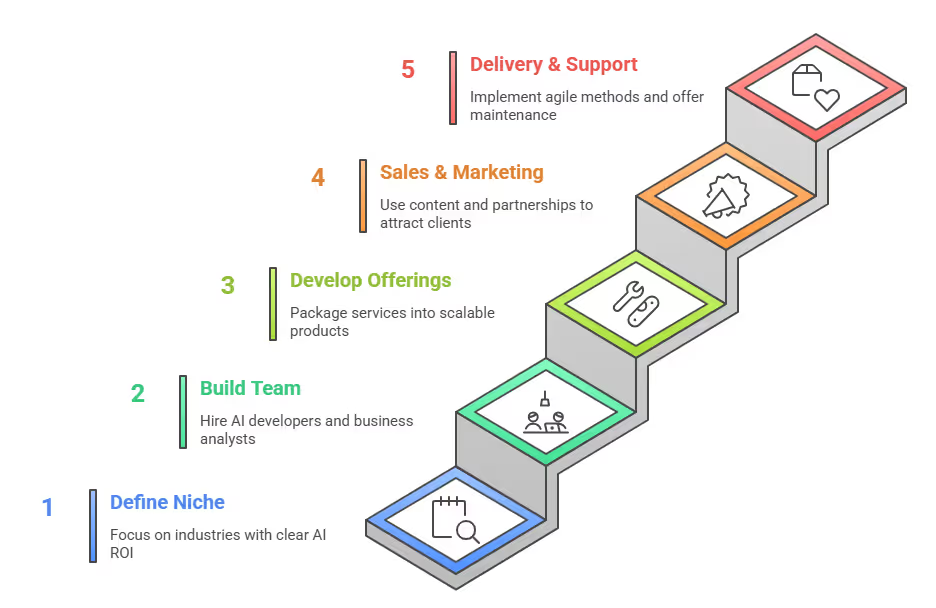
Step 1: Define Your Niche
Don’t be a generalist. Focus on industries you understand and where AI delivers clear ROI.
Examples:
- Healthcare: Patient onboarding and compliance reporting.
- E-Commerce: Order management and personalized recommendations.
Step 2: Build Your Team
You can’t do it alone. Start with:
- An AI developer experienced in frameworks like LangChain or Microsoft Autogen.
- A business analyst who can translate client needs into technical specs.
Consider outsourcing to reduce costs. Some agencies use talent from India or Eastern Europe at $40–$60/hour.
Step 3: Develop Your Offerings
Package your services into scalable products:
- AI Voice Agents: For customer service and sales calls. Authority AI charges monthly retainers for these services.
- Workflow Automation: Using tools like Make.com or n8n to automate processes.
Step 4: Sales & Marketing
- Content Marketing: Share case studies and insights on LinkedIn.
- Partnerships: Collaborate with CRM consultants, digital agencies, and IT providers.
Step 5: Delivery & Ongoing Support
- Use agile methodologies to iterate quickly.
- Offer maintenance plans at 20–30% of project cost annually.
Key Business Models to Monetize Your AI Expertise
When starting your agency, you'll need to decide on a pricing and delivery model. The choice depends on your technical skill and your client's needs.
- Project-Based Model: This is the most common starting point. You charge a fixed fee for a one-off automation build. This is great for building an initial portfolio and proving your value. For example, you might charge a flat fee of $5,000 to $15,000 for a single lead-qualification bot for a California-based law firm. The risk here is a lack of recurring revenue.
- Subscription or Retainer Model: This model involves charging a recurring monthly fee for ongoing services. This is ideal for agencies that provide continuous support, monitoring, and optimization. A client might pay $1,500/month for a service that includes automated reporting, predictive analytics, and proactive system maintenance. This creates a stable revenue stream and builds long-term client relationships.
- Performance-Based Model: This is a more advanced model where your payment is tied to the results you deliver. For example, you might get a percentage of the cost savings or a commission on new revenue generated by your automation. A common approach is a hybrid model where you charge a smaller upfront fee plus a performance-based component. This requires a high level of trust and clear ROI metrics, which is why it's less common for new agencies.
- Hybrid Model (The Recommended Approach): My recommendation, especially for those targeting the U.S. market, is to start with a project-based model to get initial traction, then transition clients to a retainer model once you've proven the value. This provides the best of both worlds: a quick cash injection and a predictable income stream.
Credits: LiamOttley
How to Identify Potential Customers for AI Automation
The biggest mistake I've seen aspiring AI agency owners make is trying to be a generalist. They'll say, “We do AI for everyone.” But the most successful agencies don't sell AI; they sell solutions to a specific industry's problems.
You must specialize. Don't be an amateur in every niche, be a master of one. Think of a financial services firm in New York City or a manufacturing plant in the Midwest. They have specific, measurable pain points that AI can solve.
Finding Your Vertical
In the U.S.A, some of the most profitable verticals for AI automation include:
- E-commerce & Retail: Automating customer service, personalized product recommendations, and inventory management.
- Healthcare & Medtech: Streamlining patient intake, automating medical billing, and improving clinical documentation.
- Professional Services: Automating lead qualification for law firms or generating personalized content for marketing agencies.
- Manufacturing & Logistics: Implementing predictive maintenance systems and optimizing supply chain operations.
- Finance & Banking: Automating fraud detection, compliance checks, and customer service inquiries.
By focusing on a single industry, you can become the go-to expert. You'll understand the jargon, the specific regulations (like HIPAA in healthcare), and the business metrics that matter most to your clients. This builds the trust and authority necessary to win enterprise-level deals.
AI Automation Agency: Building E-E-A-T and Case Studies
In a world full of AI hype, your agency’s success hinges on proving you are a legitimate expert. For U.S. clients, this means demonstrating Experience, Expertise, Authority, and Trust (E-E-A-T).
Showcasing Real Results
The most powerful sales tool you have is a case study. I’m not talking about generic, "we saved a company time" stories.
I mean specific, data-driven examples.
Case Study: Automating a U.S. E-commerce Store's Customer Support
- Client: A mid-sized e-commerce brand based in Austin, Texas.
- Pain Point: Their small customer service team was overwhelmed by repetitive queries like "Where is my order?" or "How do I return this item?" This led to slow response times, low customer satisfaction scores, and employee burnout.
- Solution: We developed and deployed a Generative AI Agent for Sales Calling using Voiceflow, integrated with their Shopify and Gorgias customer service platforms. The agent was trained on their specific product catalog, return policies, and shipping data.
- Result: Within three months, the bot was handling over 60% of all customer inquiries without human intervention. This resulted in a 30% reduction in support costs and a 15% increase in customer satisfaction due to instant, 24/7 support. The client was able to reassign their support team to focus on high-value, complex customer issues.
This kind of detailed case study, with specific metrics and a clear problem-solution-result narrative, is what builds trust and wins new business.
In B2B environments, AI agents must integrate deeply with legacy databases, CRM systems, and compliance workflows. Organizations adopting agent-driven automation often require custom AI agent solutions tailored to their existing infrastructure and governance models.
Business Models for an AI Automation Agency
The Future of AI Automation Agencies
By 2026, AI agents will become "virtual coworkers" that autonomously orchestrate multi-step workflows .
Agencies must adapt by:
- Focusing on Multi-Agent Systems: Deploying teams of specialized agents for complex tasks.
- Prioritizing Security and Compliance: Especially in healthcare and finance.
- Adopting AI Agent Platforms: Using tools like Moveworks to accelerate deployment .
For US-based agencies, the key is to focus on value, not vanity metrics. Clients care about cost savings, revenue growth, and efficiency, not the complexity of your AI models.
Want to Build Your Own AI Agent? Let’s Do It Together
We had shared some of my experiences building AI agents at Hakuna Matata, but there’s nothing like seeing it in action for your specific business.
That’s why we’re offering a free 45-minute AI Agent Strategy Session.
During this call, we’ll:
- Analyze your current sales workflow to identify automation opportunities
- Outline a potential AI agent architecture tailored to your business
- Provide a roadmap for implementation with realistic timelines and outcomes
- Answer any questions you have about the process
No sales pitch, no obligation – just practical insights from someone who’s built these systems for companies like yours.
Ready to see how AI agents could transform your sales process? schedule your free AI Agent Strategy Session – it takes just 30 seconds to book your spot.
Trust us, whether you end up working with us or not, you’ll walk away with valuable insights that could change how you think about AI for your business. What do you have to lose?
